


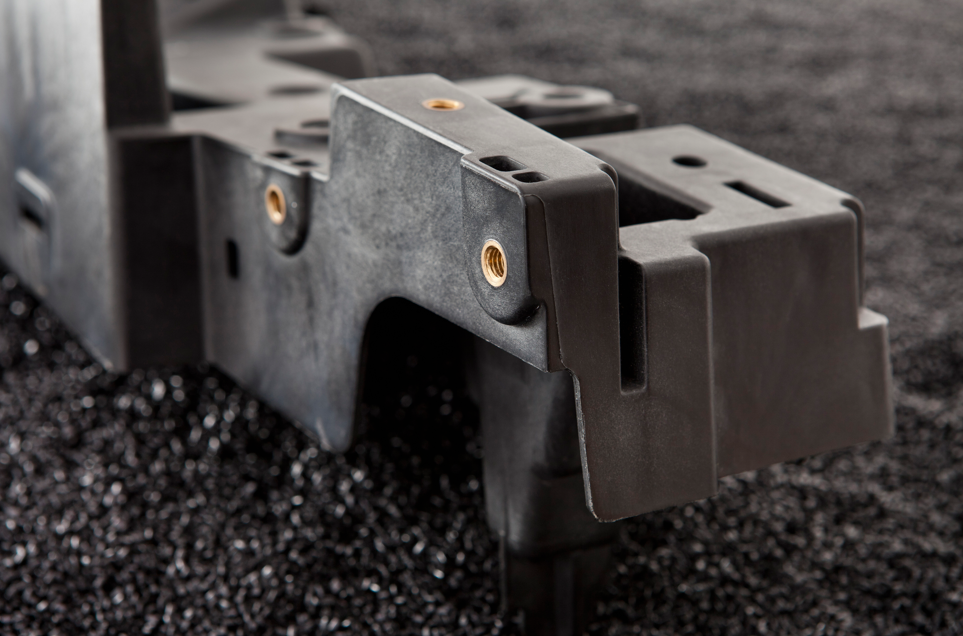
For decades, metals like steel, aluminum, and die-cast alloys were considered the default choice for structural parts. Their strength and rigidity made them reliable for load-bearing components across automotive, industrial, and consumer applications.
But advances in engineered thermoplastics are changing that equation. Materials such as semi-aromatic polyamides like LEONA™ SG and glass-reinforced polypropylene (Thermylene®) now offer stiffness, durability, and impact resistance strong enough to replace metal in many real-world applications.
For engineers and product designers, the key question is no longer whether plastics can replace metal—but when it makes sense to do so.
The Advantages of Metal Replacement
Replacing metal with engineered polymers can unlock several advantages beyond simple weight reduction.
Weight Reduction
One of the most immediate benefits is lower mass. Polymer components can often reduce weight by 20–40% compared to aluminum and even more compared to steel.
This is particularly important in industries such as automotive and transportation, where lightweighting improves fuel efficiency, reduces emissions, and extends electric vehicle range.
Corrosion Resistance
Unlike steel or aluminum, reinforced polymers do not rust or corrode when exposed to moisture, chemicals, or road salt.
This makes them ideal for outdoor structural components, including retail equipment, transportation parts, and exterior automotive applications.
Manufacturing Efficiency
Metal components frequently require multiple manufacturing steps including casting, machining, welding, and finishing.
Injection-molded polymer parts can often be produced in a single molding process, enabling:
- Part consolidation
- Reduced assembly steps
- Lower manufacturing costs
- Faster production cycles
Design Flexibility
Thermoplastics allow engineers to incorporate ribs, clips, and mounting features directly into a molded component. This reduces part count and simplifies product design.
Complex geometries that would be expensive or impossible to produce with metal can often be molded efficiently using engineered polymers.
When LEONA™ SG Replaces Metal
In applications requiring higher stiffness and heat resistance, LEONA SG provides another level of performance.
These semi-aromatic polyamide grades combine polyamide 66 with polyamide 6I with glass fibers (40-60%) to deliver:
- High rigidity comparable to magnesium or aluminum
- Excellent dimensional stability
- Reduced property variation from moisture absorption
- Strong fatigue resistance
LEONA SG is particularly well-suited for structural automotive components such as:
- Mirror brackets and ADAS sensor mounts
- Structural brackets and cross members
- Pedal arms and seat structures
- Camera housings and sensor enclosures
When Thermylene® Replaces Metal
Glass-reinforced polypropylene compounds like Thermylene are frequently used in applications where stiffness, impact resistance, and outdoor durability are required.
Typical metal replacement applications include:
- Retail equipment, such as molded shopping carts replacing traditional steel wire carts
- Industrial HVAC components, including structural grill grates and housings
- Outdoor structural parts exposed to UV and weather conditions
- Low-temperature structural components that require toughness and durability
These materials are designed to match the stiffness of long-glass polypropylene or certain metal parts while delivering better impact resistance than standard short-glass PP compounds.
Because polypropylene is naturally corrosion-resistant and lightweight, it performs well in outdoor environments where metal would require coatings or maintenance.
In these cases, the material provides the mechanical performance needed for demanding structural applications while enabling lighter designs and improved manufacturing efficiency.
The Key to Successful Metal Replacement
Replacing metal with polymer is not simply a material swap—it requires thoughtful engineering design.
Successful metal replacement typically involves:
- Optimizing rib structures and wall thickness
- Leveraging injection molding to consolidate parts
- Selecting the right reinforcement level for stiffness and toughness
When these design principles are applied correctly, modern engineering plastics can match or exceed the performance of traditional metals.
A New Era of Structural Materials
Today’s engineering resins are far more capable than the plastics of decades past. Materials like LEONA SG and Thermylene allow designers to rethink how structural parts are built, reducing weight while improving durability and manufacturing efficiency.
As industries continue to prioritize lightweighting, sustainability, and cost efficiency, the role of advanced polymers in structural design will only continue to grow.
For many applications, the question is no longer whether plastic can replace metal. The real question is how much performance and efficiency you can gain by making the switch.
If you're looking for expert guidance on selecting durable, high-performance materials, our team is available to help. Contact us today to learn more about how our engineered plastics can power your next project.
Help Us. Help You
Superior Performance. White Glove Service. Unrivaled Support. Learn Why Switching to Asahi Kasei Plastics North America's materials is Stress-Free.



Comments
\