


A lot of automotive parts are specified in glass-filled nylon (PA-GF) or glass-filled PBT (PBT-GF) for reasons that made sense years ago and haven't been revisited since. The engineer who chose the material is often gone; the specification carries forward from program to program on inertia. And every year, that inertia costs weight and money that the application never actually required.
This is the heart of a good VAVE (Value Analysis / Value Engineering) exercise, and it's one of the most productive places APNA works with OEMs and Tier suppliers. In many structural applications, high-performance Thermylene® PP-GF grades meet the same requirements as the incumbent PA-GF or PBT-GF — at lower weight, lower cost, and with easier processing.
The over-specification problem
Commodity PP-GF has historically been treated as a step down from engineering resins — fine for non-critical parts, but not something you'd trust with real structural loads. That assumption is where the opportunity hides.
Thermylene® P8 and P10 are high-performance engineered PP-GF grades built specifically to close that gap. Compared to commodity PP-GF, they deliver higher strength and better part performance, which changes the calculus entirely: a grade that once couldn't compete with PA-GF or PBT-GF now becomes a credible replacement for it.
The value proposition compounds quickly:
- Higher strength than commodity PP-GF, enabling better part performance
- Thin-walling design made possible by the improved mechanical properties
- Weight reduction potential versus the incumbent engineering resin
- Better surface finish and lower carbon footprint, because less glass fiber is needed to hit the target
- Potential to replace PA-GF or PBT-GF outright in the right applications
- Potential cost savings across material and processing
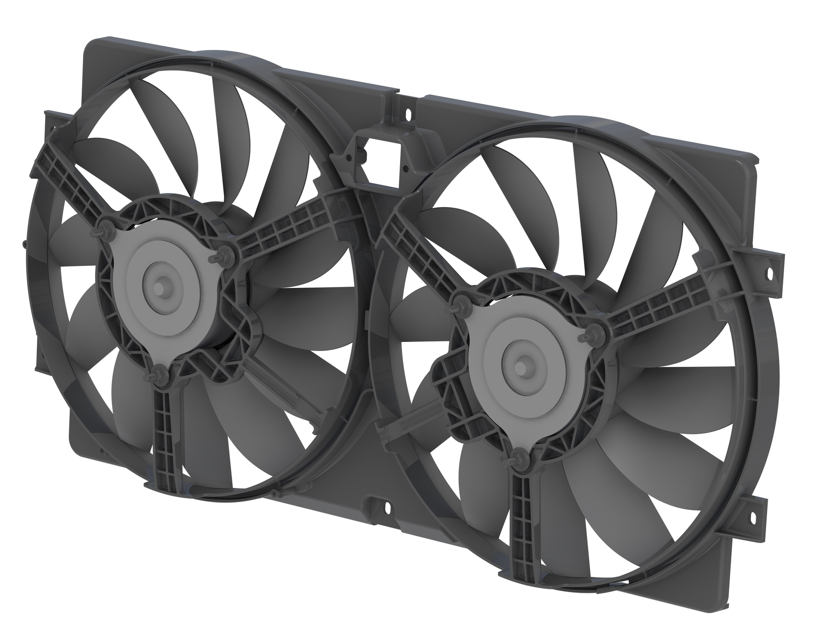
The clearest example is a fan-shroud application. The incumbent material was PA6-GF30 — a glass-filled nylon that had done the job for years. Converting it to Thermylene® PP-GF30 delivered weight reduction, cost savings, and easier molding, all at once.
The numbers tell the story: 360 grams of mass reduction per part, which translated into a reduction of roughly 60 tons of resin purchases per year across the program volume. That's not a marginal optimization — it's a structural change to the cost and weight profile of the part, achieved without giving up the performance the application requires.
Where this works: structural parts across the vehicle
The economic-selection play shows up across a wide range of structural components. Recent conversions have moved door modules from long-glass PP to Thermylene® P8, sunroof modules from PBT/ASA/long-glass-PP blends to Thermylene®, and HVAC parts from 20% mineral PP to a high-performance 12% mineral PP that does more with less filler.
The common thread: each part was carrying more material cost, more weight, or more glass than the application actually demanded — and each one gave that excess back once the resin was re-selected.
Run the VAVE exercise on your part
If you have structural parts specified in PA-GF or PBT-GF, or commodity PP-GF parts that are heavier than they need to be, there's a good chance a Thermylene® high-performance grade can take weight and cost out without compromising performance.
Ready to improve the performance of your parts in automotive & industrial applications? Contact us today to learn more about how our engineered plastics can power your next project.
Help Us. Help You
Superior Performance. White Glove Service. Unrivaled Support. Learn Why Switching to Asahi Kasei Plastics North America's materials is Stress-Free.


Comments
\