


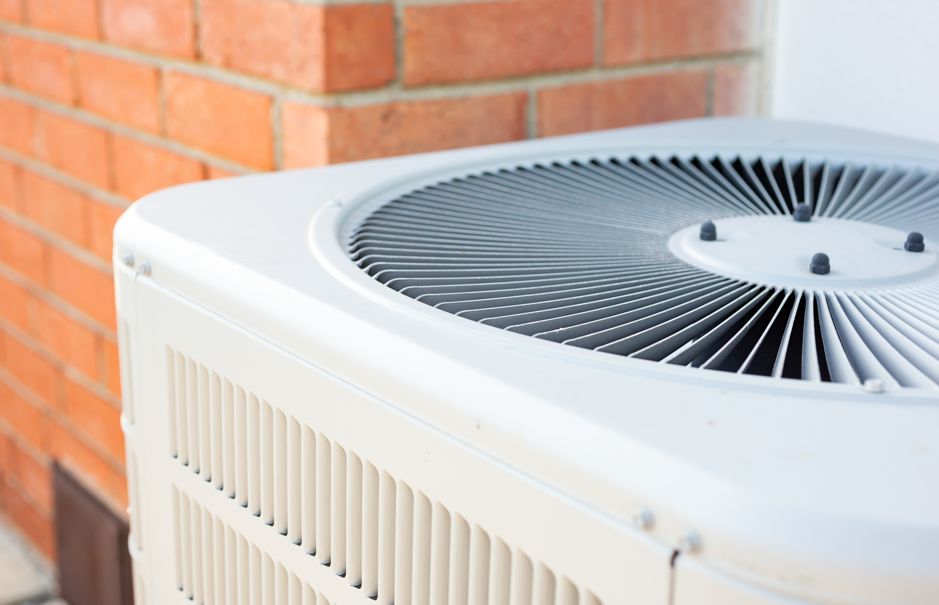
Outdoor HVAC equipment spends its entire service life exposed to the elements.
Rain, humidity, sunlight, temperature swings, debris, chemicals, vibration, and routine servicing all place demands on the materials used to protect the system.
One component that experiences many of these conditions is the condenser fan grille.
Located above the fan assembly on many outdoor units, the grille needs to help prevent accidental contact and intrusion from debris while allowing the airflow required for the system to operate effectively.
Metal has traditionally been a logical material for this application because of its rigidity and durability.
But metal also introduces challenges.
For the right condenser design, glass-fiber reinforced polypropylene can provide another option—one that combines structural performance with corrosion resistance, low weight, design flexibility, and efficient high-volume manufacturing.
The question is not whether plastic is universally better than metal.
It is whether metal is still the most efficient material for the specific fan-grille design.
What Does an HVAC Condenser Fan Grille Need to Do?
At first glance, a fan grille may appear to be a relatively simple component.
Its requirements tell a different story.
A condenser grille may need to provide:
- Sufficient stiffness to maintain its geometry
- Resistance to impacts and accidental loading
- Long-term outdoor weatherability
- UV resistance
- Dimensional stability
- Resistance to moisture
- Durability across temperature changes
- Secure attachment to the condenser assembly
- Adequate open area for airflow
- Consistent appearance throughout the equipment's service life
It also needs to be manufactured economically at the volumes required by the HVAC industry.
This combination makes the grille an interesting candidate for material optimization.
The Advantages—and Limitations—of Metal
Steel and aluminum offer obvious advantages for protective structures.
They are rigid, familiar to designers, and supported by well-established fabrication methods.
But an outdoor condenser puts metal in a demanding environment.
Depending on the material and design, manufacturers may need to address:
- Corrosion
- Paint or coating requirements
- Scratching or coating damage
- Multiple fabrication steps
- Welded or assembled sections
- Component weight
- Vibration and potential noise
- Long-term outdoor appearance
Steel components in particular generally require some form of corrosion protection for prolonged outdoor use.
Painting or coating solves an important performance problem, but it also becomes another manufacturing operation to manage.
Stamping, forming, welding, coating, and assembly can all contribute to the total cost and complexity of the finished grille.
This creates an opportunity to ask whether the component could be designed differently around an engineered polymer.
Why Reinforced Polypropylene Can Make Sense
Standard polypropylene would not provide the stiffness required for every structural fan-grille design.
Reinforcement changes the equation.
Glass-fiber reinforced polypropylene compounds such as Thermylene® combine polypropylene's low density and resistance to moisture with increased stiffness and mechanical performance.
Depending on the grade and part design, Thermylene® can be tailored to provide combinations of:
- Stiffness
- Strength
- Toughness
- Creep resistance
- Chemical resistance
- UV and weathering performance
- Dimensional stability
- Surface appearance
For an outdoor condenser grille, the ability to combine structural performance and environmental resistance in one molded material can be particularly useful.
Unlike steel, polypropylene does not rust.
That immediately removes one of the fundamental concerns associated with exposing a structural component to rain and humidity for years.
Corrosion Resistance Can Simplify the Part System
Corrosion resistance is about more than preventing an unattractive surface.
It can affect how the entire component is manufactured.
A metal grille may require coatings or other surface treatments designed to protect the substrate from its operating environment.
A properly formulated polypropylene component does not depend on a paint layer to protect it from rust.
For manufacturers, this can create an opportunity to evaluate whether secondary finishing steps can be reduced or eliminated.
Potential benefits can include:
- Fewer manufacturing operations
- Less handling between processes
- Elimination of coating-related defects
- Reduced concern about chips exposing underlying metal
- Consistent material throughout the component
The actual economics depend on the part, tooling, production volume, design, and manufacturing process.
But metal replacement should be evaluated based on total system cost, not simply the price per pound of resin versus steel.
Weight Reduction Matters Even in Stationary Equipment
HVAC systems are not vehicles, so reducing weight does not improve fuel economy or battery range.
That does not mean weight is irrelevant.
A lighter component can make equipment easier to:
- Handle during manufacturing
- Move through assembly operations
- Package
- Ship
- Lift or position during installation
- Remove during service
The impact of one grille may be modest, but manufacturers producing large volumes of outdoor units can benefit from removing unnecessary material and mass where the application allows it.
Polypropylene's relatively low density gives it an inherent advantage when weight reduction is one of the design objectives.
Injection Molding Opens Different Design Possibilities
The biggest opportunity may not come from recreating a metal grille in plastic.
It may come from redesigning the grille around injection molding.
Polymer components can incorporate functional geometry directly into the molded part.
Depending on the design, engineers may be able to integrate:
- Structural ribs
- Reinforced mounting areas
- Attachment features
- Fastener locations
- Curved airflow surfaces
- Protective geometry
- Branding or surface textures
- Multiple functions previously handled by separate pieces
Ribbing is especially important.
Instead of relying solely on material thickness for stiffness, engineers can use geometry to increase structural performance in targeted areas.
This can allow a molded polymer design to put material where it adds the most value without simply making the entire component thicker.
That is why successful metal replacement rarely begins with a one-for-one material substitution.
The part should be designed around the behavior and processing advantages of the polymer.
Outdoor Weatherability Has to Be Engineered In
A grille installed on top of an outdoor condenser may experience years of sunlight, rain, snow, humidity, and temperature cycling.
Any polymer being considered needs to be formulated for those conditions.
UV exposure is particularly important because prolonged sunlight can degrade polymers that are not properly stabilized.
Thermylene® formulations can be tailored for UV and weathering requirements, helping support long-term outdoor applications.
The exact requirements should still be defined during development.
Questions to consider include:
- Where will the equipment be installed?
- What is the expected service life?
- What temperatures will the grille experience?
- How much direct sunlight will it receive?
- Are color and appearance retention important?
- What cleaning agents or environmental chemicals may contact the part?
- What impact and loading requirements apply?
Answering these questions helps determine the appropriate filler level, stabilization package, mechanical-performance target, and overall formulation.
Impact and Toughness Matter Too
Stiffness is important for a protective grille, but stiffness alone is not enough.
Outdoor HVAC equipment can experience accidental impacts during shipping, installation, landscaping, servicing, or everyday use.
A material that is extremely rigid but too brittle could create a different failure mode.
The desired performance is a balance of stiffness and toughness appropriate for the part geometry and operating environment.
Engineered Thermylene® grades can be formulated with different reinforcement levels and property balances, allowing the material to be matched more closely to the needs of the component.
This is particularly important in metal replacement.
The objective should be to reproduce the functional performance of the metal design, not simply one isolated mechanical property.
When Should an HVAC Manufacturer Evaluate GF-PP?
A condenser fan grille may be worth evaluating for reinforced polypropylene when several of these conditions apply:
- Corrosion resistance is important
- The metal part requires painting or coating
- Weight reduction would improve handling or logistics
- Production volumes justify injection-mold tooling
- Multiple metal pieces could potentially be consolidated
- The design could benefit from molded-in ribs or mounting features
- Outdoor UV and weathering requirements can be addressed through the formulation
- The application fits within the mechanical and thermal capabilities of reinforced PP
Not every grille will be a candidate.
Certain loads, temperatures, dimensions, regulatory requirements, or equipment designs may continue to favor metal.
The goal is not to replace metal simply because a polymer alternative exists.
The goal is to identify applications where the polymer provides a better overall balance of performance, manufacturing, durability, and cost.
Think Beyond the Material Price
When engineers compare a metal component with a molded polymer component, resin price and metal price are only part of the equation.
The complete comparison should consider:
- Part weight
- Fabrication steps
- Coating or painting
- Welding
- Assembly
- Scrap
- Corrosion protection
- Tooling
- Production volume
- Cycle time
- Shipping and handling
- Part consolidation
- Long-term durability
That broader VAVE approach often provides a much clearer picture of whether a material conversion makes sense.
A reinforced polypropylene grille may have value not because polypropylene is simply “cheaper,” but because the material can enable a different manufacturing and design strategy.
A Different Approach to Outdoor HVAC Design
Metal remains an important structural material throughout HVAC equipment, and it will continue to be the right choice for many components.
But it should not be the automatic choice for every protective structure simply because that is how the part has traditionally been made.
For condenser fan grilles and other selected outdoor components, glass-fiber reinforced polypropylene can provide a combination of low weight, corrosion resistance, structural performance, weatherability, and injection-molding design freedom.
Thermylene® compounds give engineers the ability to tailor reinforcement, stiffness, toughness, UV performance, appearance, and other properties around the actual application.
The result can be more than a metal replacement.
It can be an opportunity to redesign the component around a more efficient material and manufacturing process.
Frequently Asked Questions
Can polypropylene be used outdoors in HVAC equipment?
Yes, when the grade and formulation are designed for the application's UV, weathering, temperature, mechanical, and environmental requirements. Outdoor applications should always be evaluated using the expected service conditions.
Why use glass-filled polypropylene instead of standard polypropylene?
Glass reinforcement increases stiffness and mechanical performance, making reinforced polypropylene more suitable for structural and semi-structural applications where standard PP may not provide enough rigidity.
What are the benefits of replacing a metal HVAC grille with reinforced polypropylene?
Potential benefits can include lower weight, corrosion resistance, reduced secondary finishing, injection-molded design flexibility, part consolidation, and simplified manufacturing.
Is your HVAC component a candidate for metal replacement?
Want to test Asahi Kasei materials in your HVAC application? Contact our technical experts today to request a sample or discuss how our formulations can meet your design requirements.
Help Us. Help You.
Superior Performance. White Glove Service. Unrivaled Support. Learn Why Switching to Asahi Kasei Plastics North America's materials is Stress-Free.



Comments
\