


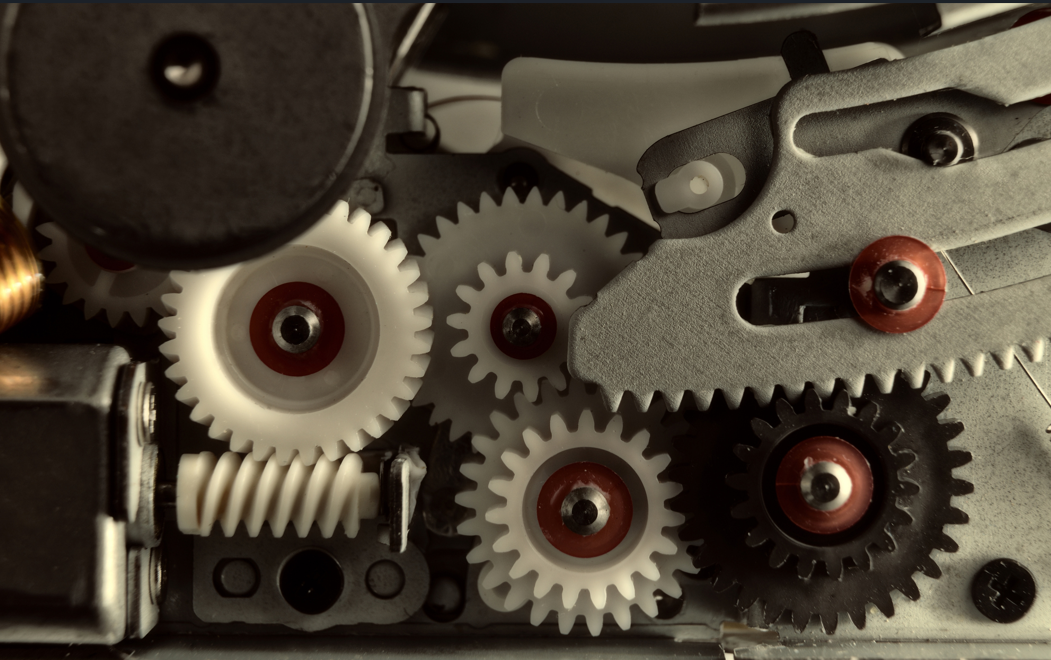
Many plastic components spend their entire service life sitting still.
Others slide, rotate, engage, disengage, carry a load, and repeat the same motion thousands—or millions—of times.
For gears, bearings, actuators, latches, rollers, and other precision mechanisms, that difference matters.
Material selection has to account not only for strength, but also for friction, wear, fatigue, creep, and dimensional stability over time.
That is one reason polyoxymethylene, or POM, is widely used for moving mechanical components.
Here are five questions engineers should consider when evaluating POM for a precision mechanism.
1. Will the Part Slide or Rotate Against Another Surface?
Whenever two components move against one another, friction becomes part of the design.
Excessive friction can contribute to:
- Increased wear
- Noise
- Higher operating forces
- Heat generation
- Reduced efficiency
- Shorter component life
POM is known for its naturally good sliding properties and resistance to friction and wear. Asahi Kasei's TENAC™ and TENAC™-C POM materials are self-lubricating and are used in moving parts such as gears, axles, and bearing components.
That can make POM worth evaluating for applications such as:
- Gears
- Rollers
- Bushings
- Actuators
- Latches
- Sliding mechanisms
- Small motor components
- Office-equipment mechanisms
The mating material still matters. Plastic-on-plastic, plastic-on-metal, load, speed, lubrication, temperature, and surface finish can all change friction and wear behavior.
So the question is not simply, “Does POM have low friction?”
It is:
“How will this particular POM grade behave against the mating surface under the actual load and speed of the application?”
2. Will the Part Experience Repeated Loading?
A gear tooth may not fail the first time it carries a load.
The bigger question is what happens after it has done so hundreds of thousands of times.
Repeated loading makes fatigue resistance especially important for mechanical components.
POM's combination of toughness and fatigue performance makes it well suited to many components that experience repeated motion or cyclic loading. Asahi Kasei specifically identifies TENAC and TENAC-C as materials for components subjected to long-term and repeated loads.
That is relevant for products such as:
- Gear trains
- Repetitive actuators
- Window mechanisms
- Adjustment systems
- Mechanical controls
- Robotic components
When evaluating a resin for these applications, engineers should look beyond a single tensile-strength value on a datasheet.
A part that repeatedly moves under load needs a material that can maintain performance over the expected service life.
3. Will the Component Remain Under Load for Long Periods?
Repeated motion is one challenge.
A constant load creates another: creep.
Creep occurs when a plastic component gradually deforms while remaining under stress over time. That can affect gear alignment, actuator position, spring-loaded mechanisms, dimensional tolerances, and other precision functions.
POM generally offers good creep resistance, which is one reason it is commonly considered for mechanical applications.
For more demanding loads, specialized grades can take that performance further.
For example, TENAC MG210 is a non-reinforced POM homopolymer developed for improved creep and fatigue performance and has been used in demanding gear applications. Asahi Kasei positions it for opportunities including component miniaturization, longer service life, and selected metal-replacement applications.
That does not mean every gear needs a high-durability grade.
It means engineers should match the material to the load, duration, geometry, and required lifetime.
4. How Precise Does the Mechanism Need to Be?
Precision components often depend on small tolerances.
A gear needs proper tooth engagement. An actuator needs predictable travel. A roller or bearing surface needs to remain aligned.
That makes dimensional accuracy and warpage important.
POM can provide good dimensional performance for many precision mechanisms, and specialized compounds can be developed around even tighter requirements.
TENAC-C NS556, for example, was designed to combine high rigidity, toughness, dimensional precision, low warpage, and durability. Asahi Kasei cites large-diameter gears in office-automation equipment as one established application.
This illustrates an important point:
“POM” is a material family, not a single set of properties.
The right grade may depend on whether the priority is:
- Sliding performance
- Durability
- Rigidity
- Dimensional precision
- Processing speed
- Weather resistance
- Noise reduction
That is why grade selection matters just as much as polymer selection.
5. Could Plastic Simplify a Metal Mechanism?
POM can also become interesting when engineers are evaluating whether a small metal mechanical component really needs to remain metal.
Depending on the application, converting a component to an engineering plastic can create opportunities for:
- Lower weight
- Injection-molded complex geometry
- Fewer secondary operations
- Part consolidation
- Reduced lubrication requirements
- Lower noise
High-durability TENAC grades are used in applications including motor gears, window-regulator components, door rollers, and robotic structures, where wear, creep, and repeated loading matter.
Metal replacement is not appropriate for every mechanism. Temperature, load, stiffness, impact, tolerances, and safety requirements all need to be evaluated.
But the right question is often worth asking:
“Does this component require metal—or does it require durability, precision, and predictable motion?”
When Does POM Make Sense?
POM is especially worth evaluating when a component needs several of these characteristics together:
- Low friction
- Wear resistance
- Fatigue resistance
- Creep resistance
- Toughness
- Dimensional precision
- Resistance to oils and many organic solvents
Asahi Kasei produces both TENAC™ POM homopolymer and TENAC™-C POM copolymer, with grades tailored for different mechanical, processing, and durability requirements.
The best choice depends on the mechanism—not simply the material name.
Frequently Asked Questions
What is POM plastic?
POM stands for polyoxymethylene and is also commonly called polyacetal. It is a crystalline engineering thermoplastic known for sliding performance, fatigue resistance, creep resistance, and mechanical strength.
Is POM a good material for gears?
It can be. POM's low-friction, wear, fatigue, and creep characteristics make it widely used in gear applications. The appropriate grade depends on torque, speed, load, temperature, mating material, and expected lifetime.
Can POM replace metal gears or mechanical components?
In selected applications, yes. High-durability POM grades can support lightweighting and metal replacement, but the design must account for stiffness, loading, temperature, tolerances, and long-term performance.
Start With the Motion
Material selection for a moving component should begin with what the mechanism actually does.
How often does it move? What load does it carry? What does it slide against? How precise does it need to remain after years of use?
Answering those questions can help determine whether POM—or another engineering plastic—is the right solution.
Designing a gear, actuator, bearing, roller, or precision mechanical component? APNA can help evaluate the application requirements and identify an appropriate material and grade.
Help Us. Help You.
Superior Performance. White Glove Service. Unrivaled Support. Learn Why Switching to Asahi Kasei Plastics North America's materials is Stress-Free.




Comments
\